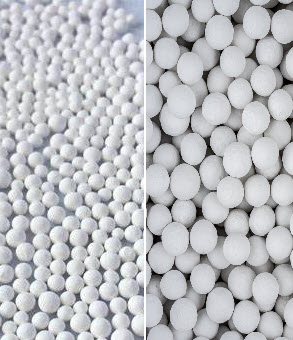
For the many different applications for Activated Alumina, purchasing the ACTIMAX® brand ensures you receive a superior quality product that has been quality tested and quality assured. ACTIMAX® Activated Alumina from M Chemical is specifically designed with high-quality, high-performance adsorption technology. Our ACTIMAX® Activated Alumina series is available for numerous industrial applications. When you choose ACTIMAX® Activated Alumina, you will enhance and optimize the removal of contaminants like fluoride, chloride, water, sulfur compounds, and other impurities that can negatively impact process performance and on-line time.
Important Features
Our ACTIMAX® Activated Alumina products offer several key features. Each product provides optimal pore structure and surface area, thus enabling the selective, efficient removal of contaminants under demanding conditions. They also offer high physical strength and resistance to fouling, which allows for longer operational life. For applications that require reliable and consistent adsorption properties, ACTIMAX® Activated Alumina is a superior choice.
Many Applications
With ACTIMAX® Activated Alumina from M Chemical, leaders in energy and industrial settings can confidently invest in a proven solution that focuses on enhancing output quality, reducing downtime, and meeting industry compliance standards, all across various applications. Our products are useful among the following applications:
– Desiccants: Regenerable drying of air, gas-phase hydrocarbons, liquid-phase hydrocarbons, and other non-polar streams.
– Claus Catalysts: Catalytic hydrolysis of COS and CS2 with equilibrium catalytic conversion of H2S and SO2 to elemental sulfur and water.
– Defluorination Products: (A) Following HF alkylation, catalytic conversion of organic fluoride to HF and olefins followed by reaction of the HF to form solid AlF3. (B) In water treatment, water can be purified by adsorption of fluoride and arsenic.
– Chloride Adsorption: Non-regenerative adsorption of HCl from H2 gas and hydrocarbons downstream of reforming units.
– Olefin Purification: (A) Catalytic hydrolysis of COS with water in hydrocarbons streams, such as polymer feeds, to form H2S and CO2, which can subsequently be removed by a chemical scrubbing system. (B) Regenerable adsorption of COS, H2S, H2O and CO2 from gas-phase and liquid-phase hydrocarbons, such as polymer feeds.
– Hydrogen Peroxide Processing: Reversion catalyst for over hydrogenated anthraquinone and a scavenger for severely over hydrogenated anthraquinone and epoxides in working solution for hydrogen peroxide production.
– HDPE Processing: Non-regenerative adsorbent for removal of dispersed titanium and vanadium chloride catalysts from product PE stream.
– Monomer Treating (TBC Removal): Partially regenerative adsorbent for removal of tert-butylcatechol and water from monomers, such as styrene, isoprene and butadiene, prior to being fed to a polymerization reactor. TBC is a polymerization inhibitor that is sometimes added to monomers for storage or shipping.
Our Commitment to Quality
M Chemical is committed to quality and innovation. When you invest in our ACTIMAX® Activated Alumina line, you can count on sustainable, superior performance in the long run. We continue to move with the global drive toward environmentally friendly practices by optimizing resource utilization. Learn more about our ACTIMAX® Activated Alumina line by contacting our team at M Chemical today. We are here to answer your questions and help you find the proper solutions for your industry and application.